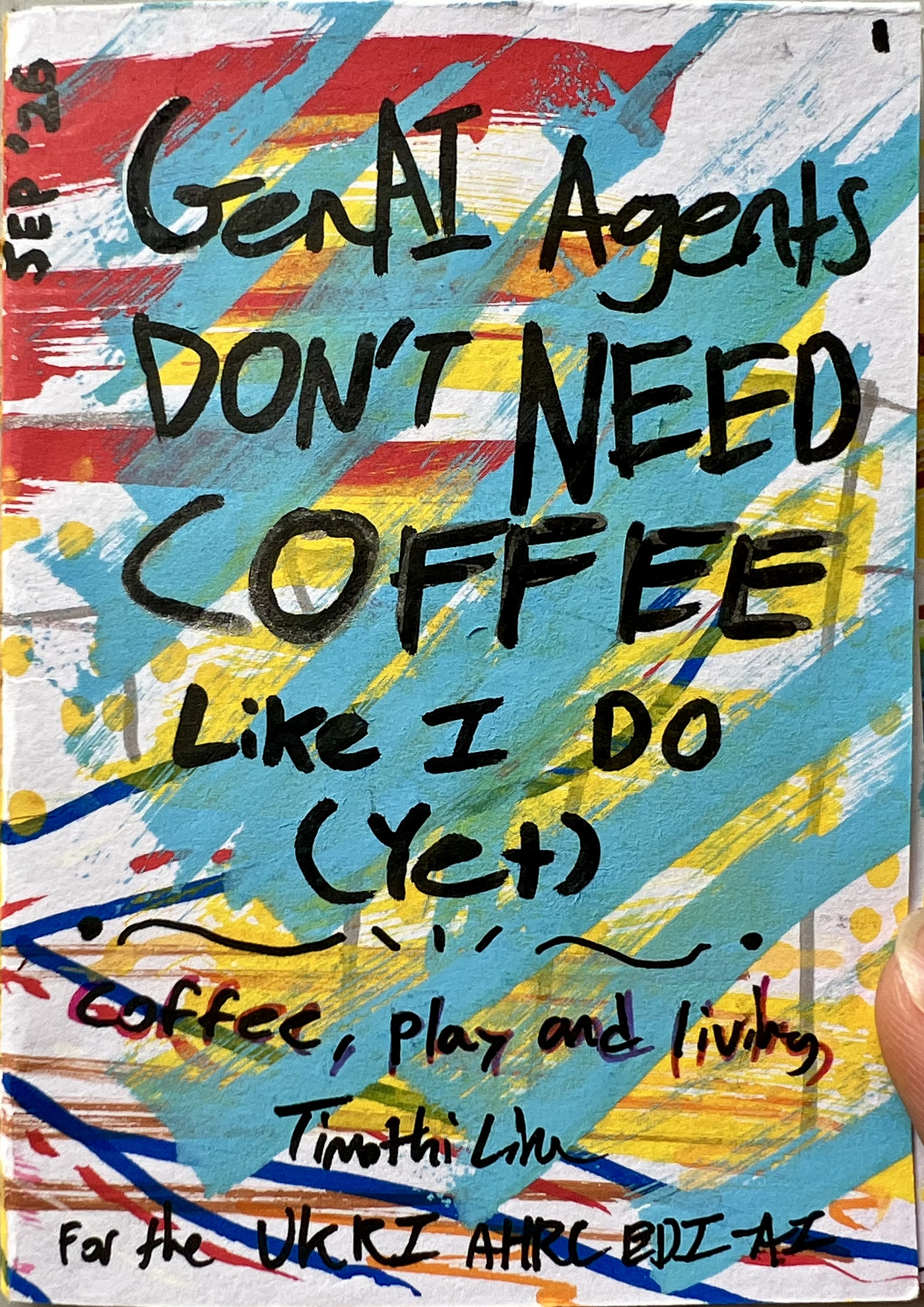
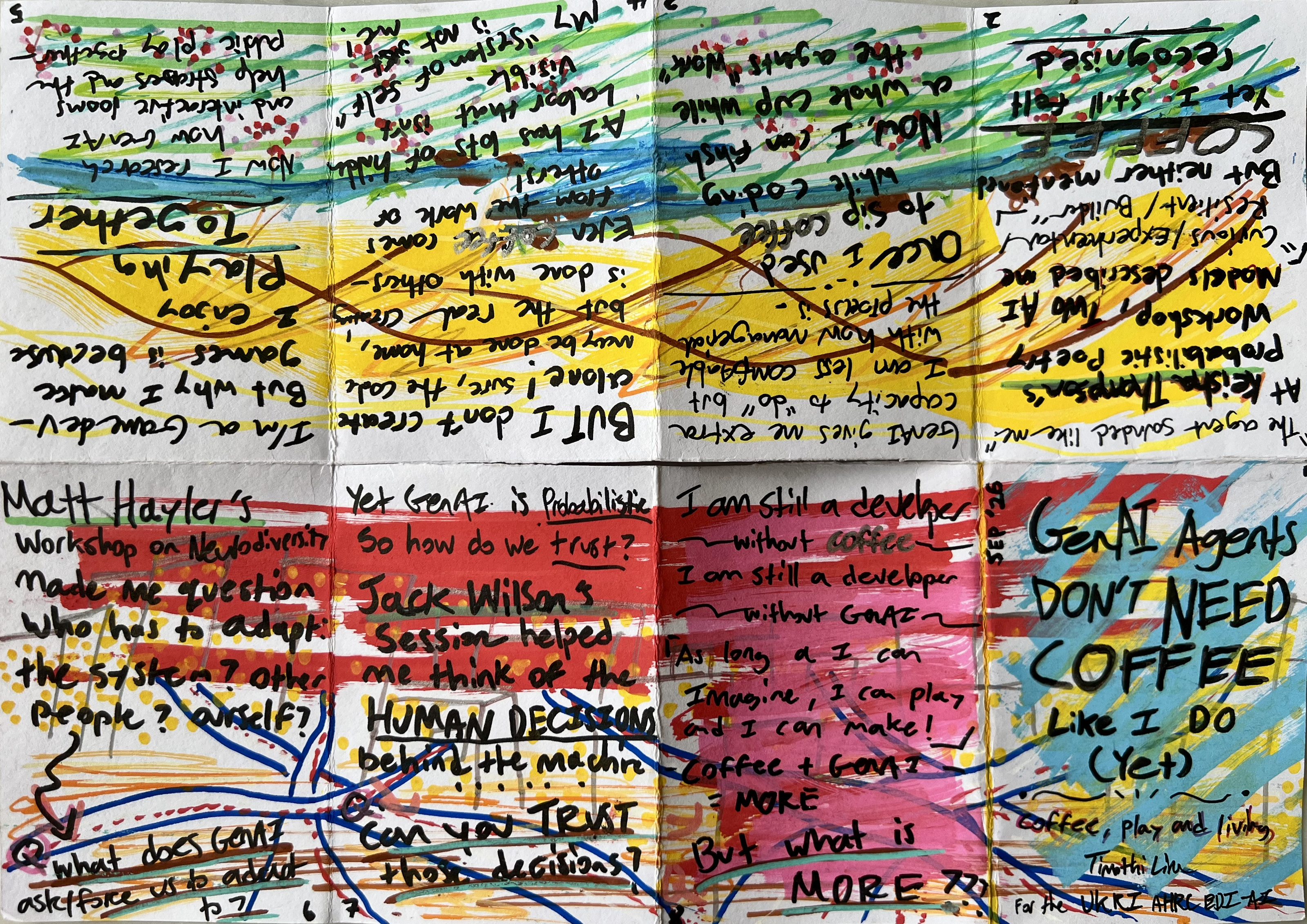
An Introduction of Coffee and Prompts
← Back to zine page 2
I spent much of my adult lifetime trying to understand what happens when machines interpret people during play, and in doing so, how that can come to affect our own social interactions in real-time. I just didn’t expect a cup of coffee to make that problem very personal during the UK AI-EDI Workshops at Salford, Manchester.
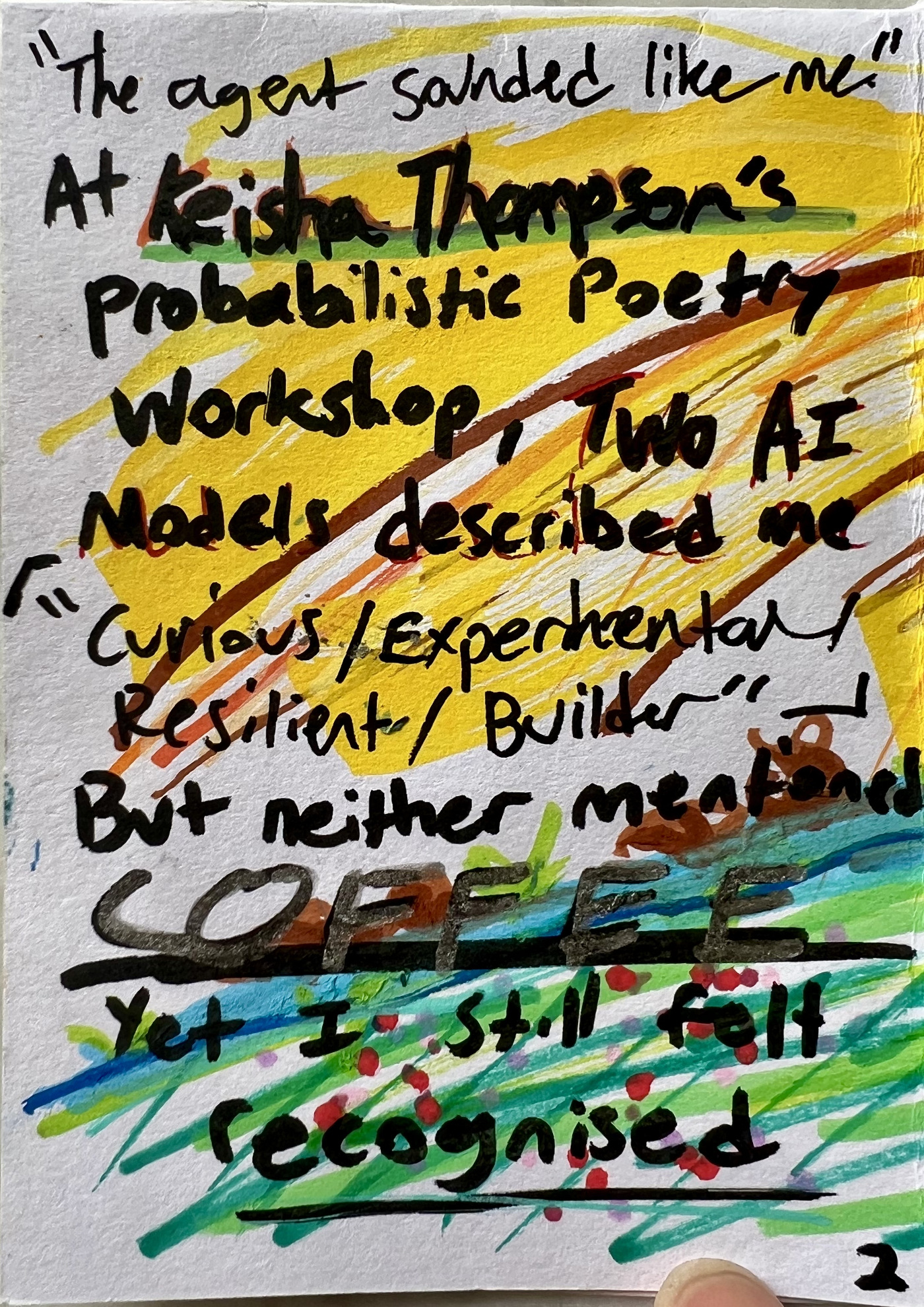
The personal revelations arrived unexpectedly amid Keisha Thompson’s probabilistic poetry workshop, where I used two Generative AI models to explore associations with words to describe myself. Among the generated responses were terms such as curiosity, experimentation, resilience and worldbuilding.
Yet, none of the models pulled up or alluded to my dire need for coffee in the morning.
Coffee has been omnipresent in my mornings for as long as I can remember. Dark coffee roasts, no milk, no sugar. Just coffee beans, roasted, ground, pressed and filtered into a dark liquid that seems to power my every being and generate the energy and ideas needed to get through the day.
Now as I get older, I am more aware about where coffee comes from, how it is harvested and transported, and how the cup in my hand depends on environmental and human systems far beyond my immediate view. Yet coffee has still become part of the fabric of my life. I do not need coffee to be a creative technologist, but through years of drinking it, coffee has changed the processes around how I work.
You must be wondering, Tim, what does coffee have to do with GenAI?
For me, GenAI has become strangely similar. It has disrupted, changed and altered the processes in my life, and as I adapt it into my workflows it has begun to become part of my daily ritual too. I sometimes wake up and check what my GenAI agents have been developing through the night, fueled by an ever-growing list of ideas, prototypes and expectations.
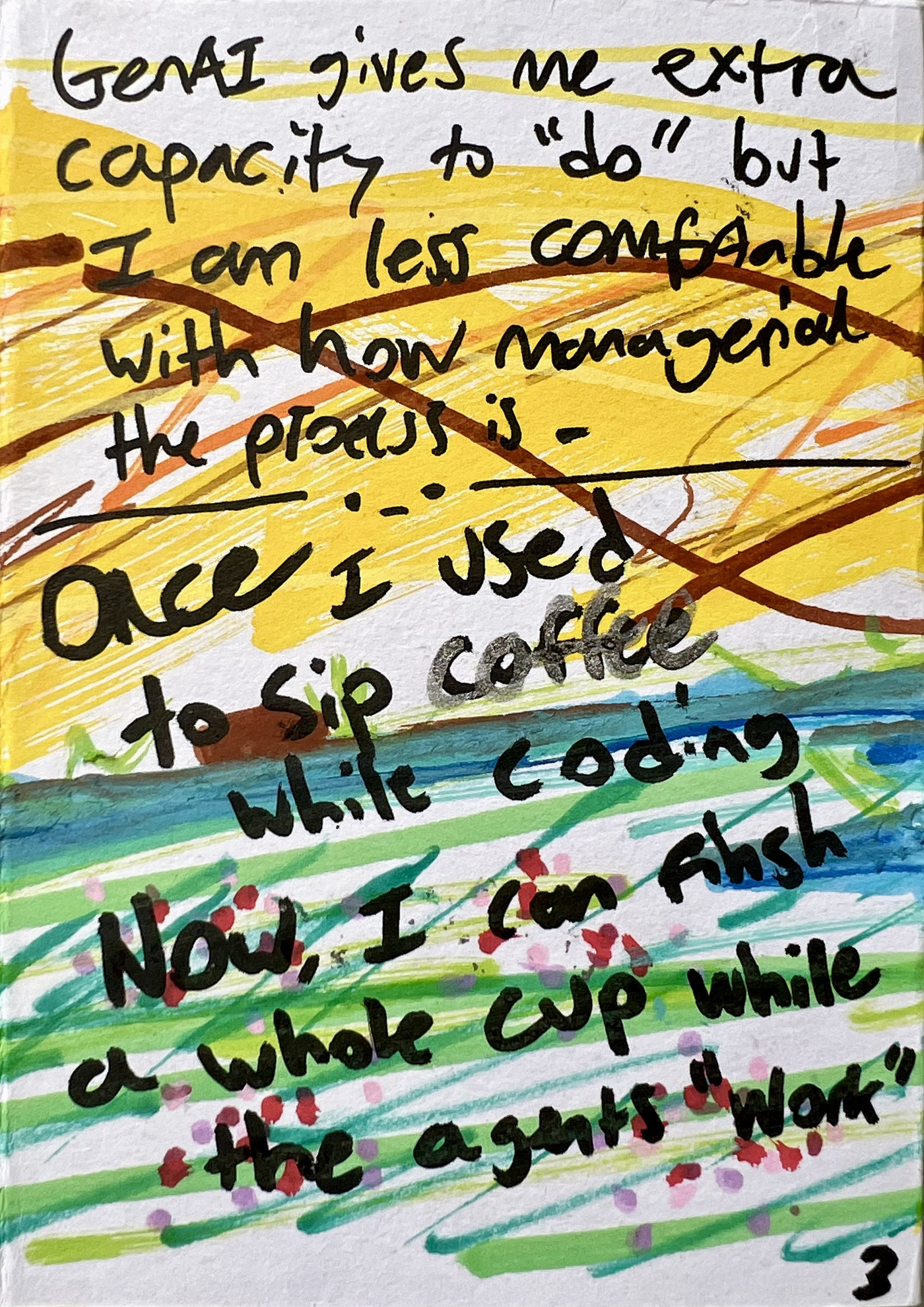
Now I sip coffee while watching GenAI agents running models such as Claude, ChatGPT, Gemini, and Kimi operate machines locally and in the cloud. I manage, judge, enquire, criticise, read, edit, code, type and talk. Once, I had to intermittently set the coffee down to write the lines of code myself. Increasingly, I find that I can hold the cup in my hand while the agent writes and I supervise, often using my spoken word to direct and oversee, reminding me of a line manager in a factory.
The models in Keisha’s workshop were responding to the information I had supplied, bounded by what they could access and remember. Despite everything the models had left out, I was quite intrigued by how readily the generated descriptors felt like recognition. Even as I re-read the words, I felt as if this thing, this model, knew at least a good enough part of me. At least enough where I thought that even a friend introducing me would also be just as incomplete. Perhaps the difference is that I am increasingly giving away authority to the machine to act on its own partial interpretation of me and also act as me (at least in development so far).
Thompson’s workshop took place during the UKRI AHRC AI-EDI programme’s residential at the University of Salford, from 7 to 9 April 2026, after three months of online workshops exploring artificial intelligence alongside equality, diversity and inclusion. I remember finishing a cup of dark coffee while staring at words a model had probabilistically assembled on my screen.
At that moment I found myself asking questions I had been trying to avoid. Is my work satisfying? Are the projects I create meaningful? If I do not use these systems, would I fall behind my peers, especially those from industry?
I do not need GenAI to be a creative technologist or the interactive developer that I am. I was already one without it. Similarly, without coffee, I would still be a creative technologist. But with them I am capable of more work, and more outputs, which means more opportunities, and more and more…and yet that doing of more becomes the definition of who I am.
There is no easy answer for my own tribulations. So, for now, the question I keep in mind is “how might we flourish together; as nature, humans, and now these increasingly generally ‘intelligent’ machines?”
Developing Interactions
I used to joke that I extract resources from nature, such as in the form of coffee, to build things. Nature gives me the energy to work and, in return, I create goods and services for other people, mostly interactive entertainment through digital and physical games. In doing so, I build respite for the workforce, and once the rest and entertainment has been had, the workforce can again work.
For a long time, I imagined that perhaps the coffee farmer might one day play something I had made and find a little respite in it. Later I realised how naive that picture was. The people whose labour supported my coffee mostly do not have the time, money, connectivity or interest to play the games I was building. That realisation made my own privilege harder to ignore.
I grew up in Singapore, fighting for high grades and finding a weird comfort in winning games such as StarCraft, Age of Empires II, Counter-Strike and Dota. LAN gaming centres and internet cafés made up a big chunk of my childhood. I would sneak out after school, change out of my uniform (because students were not allowed to play in school uniform), and head over with friends to compete with other groups.
There were laughs, tears and the occasional shouting match, but the computer gaming space became a social space. Winning was momentary. Compared with the laborious march of grades that everyone told me would define the success of my future, games gave me feedback immediately. I could be successful now and see the word VICTORY flash on the screen.
Yet for every win there were many more losses, and eventually it was not really about winning or losing. It was about the interaction we had, with the designed system and with other players. For me, the possibilities of a designed system; its affordances, became what mattered.
That followed me into professional work and now into my PhD.
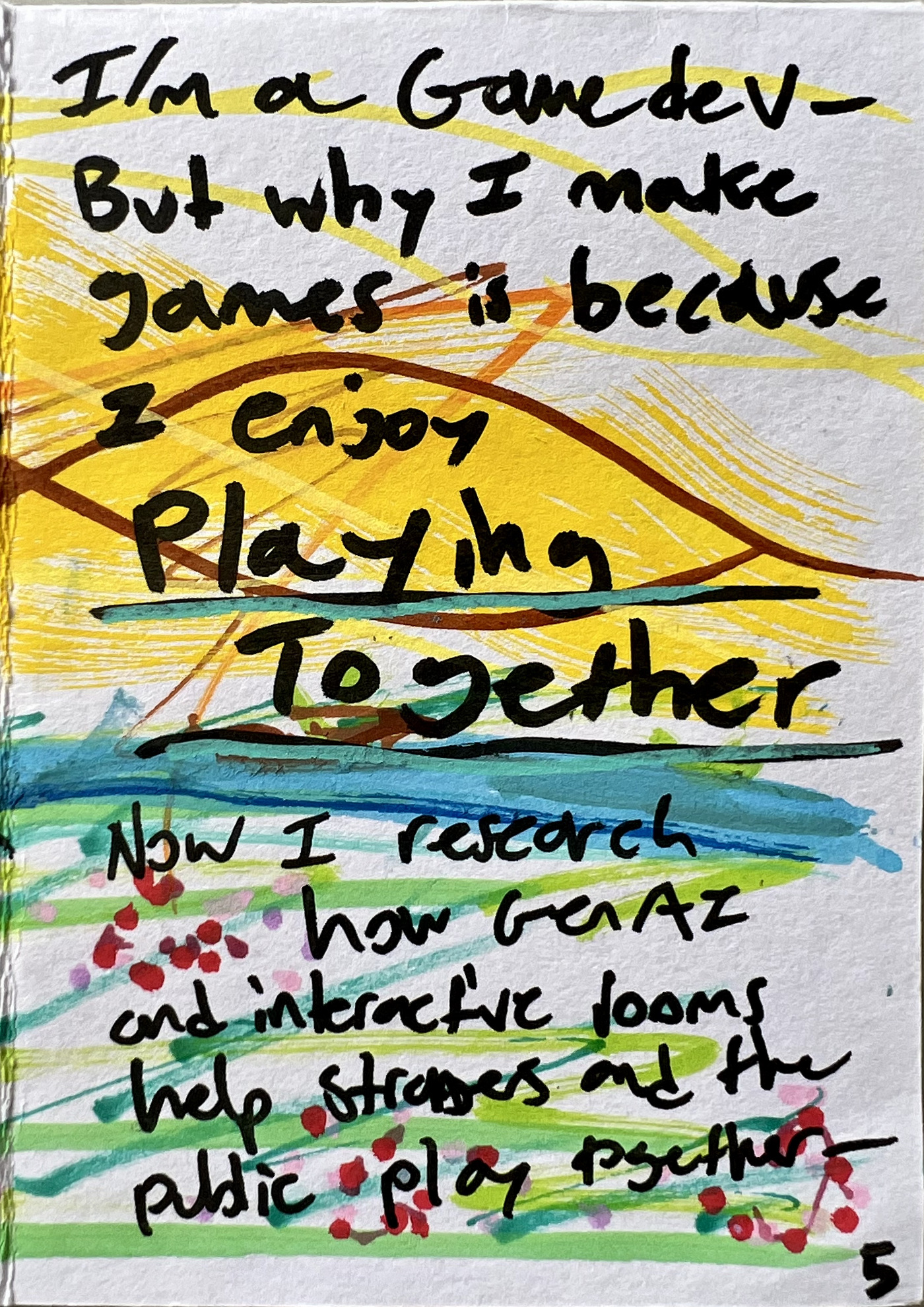
My practice-based PhD at De Montfort University (DMU) explores Social Extended Reality, or Social XR, in themed entertainment (Midland4Cities CDA in collaboration with Holovis International). For my practice, I build room-scale immersive experiences where small groups share a physical space and interact with digital imagery, sound and motion-tracking systems. My research asks how generative AI might help strangers cooperate through nonverbal cues, such as an arrow or a sound that draws attention to part of the interactive environment.
The aim is, as it has always been for me, to help people find the affordances to play together.
But even that word ‘help’, carries many assumptions.
When people struggle in my experiences, I look for something I can redesign. The AI-EDI workshops enabled me to look more closely at what happens when the AI system I am designing around is opaque, probabilistic and built on labour I rarely see.
The discussions of hidden labour continue to haunt me. I enjoy the increased productive capacity GenAI gives me, yet I am less comfortable with how managerial the arrangement can feel. Part of the pleasure in my practice comes from making something, coding it, designing, and learning during the process. Yet, there is a perverse pleasure that comes from watching something work for me. In my own further reading, I found Madhumita Murgia’s Code Dependent and Nick Couldry’s work around Data Colonialism as providing the insight needed for me to understand the vast international labour and infrastructure behind GenAI. Just as I am more aware of how my drinking coffee connects globally, now I am more aware of the interconnections that make GenAI possible.
With a GenAI agent though, I find that it does not ask enough questions unless I explicitly instruct it to do so, repeatedly.
That is ultimately the part I find most unsettling; that the machine assumes and doesn’t really ‘care’ all that much for me; if even capable of caring, of which so far, it is not.
Questions are a significant part of creative and research work for me. The innovations, challenges and compromises that emerge from those questions eventually shape the designed system, its affordances and its limits. If GenAI automates away some of those questions, it changes not only how quickly I work but how I think through the work.
After all, I am still a developer without coffee and without GenAI. If I think, I can imagine, and thus I can also play (and vice versa of playing, then imagining and reflectively or retrospectively thinking).
So in adopting new technologies and new workflows, am I adapting, or am I being forced to adapt?
What is lost when I adapt?
Have you ever tried to make something that can adapt?
In video games, I have worked on systems that use procedural, evolutionary or recommendation algorithms to adjust an experience around a player. The hope is usually straightforward; understand the player well enough to keep them engaged. In commercial games, metrics such as session length, 30-day return rates, average spending and daily active users can become proxies for whether the experience is succeeding.
That means adaptation can be quickly designed to serve business interests before it serves the needs of the player/person.
So when I adapt my own workflows to fit GenAI, I find myself asking the same question. Am I choosing the tool because it helps me, or am I being compelled/forced/cajoled to adapt into a loop designed around somebody else’s definition of productivity?
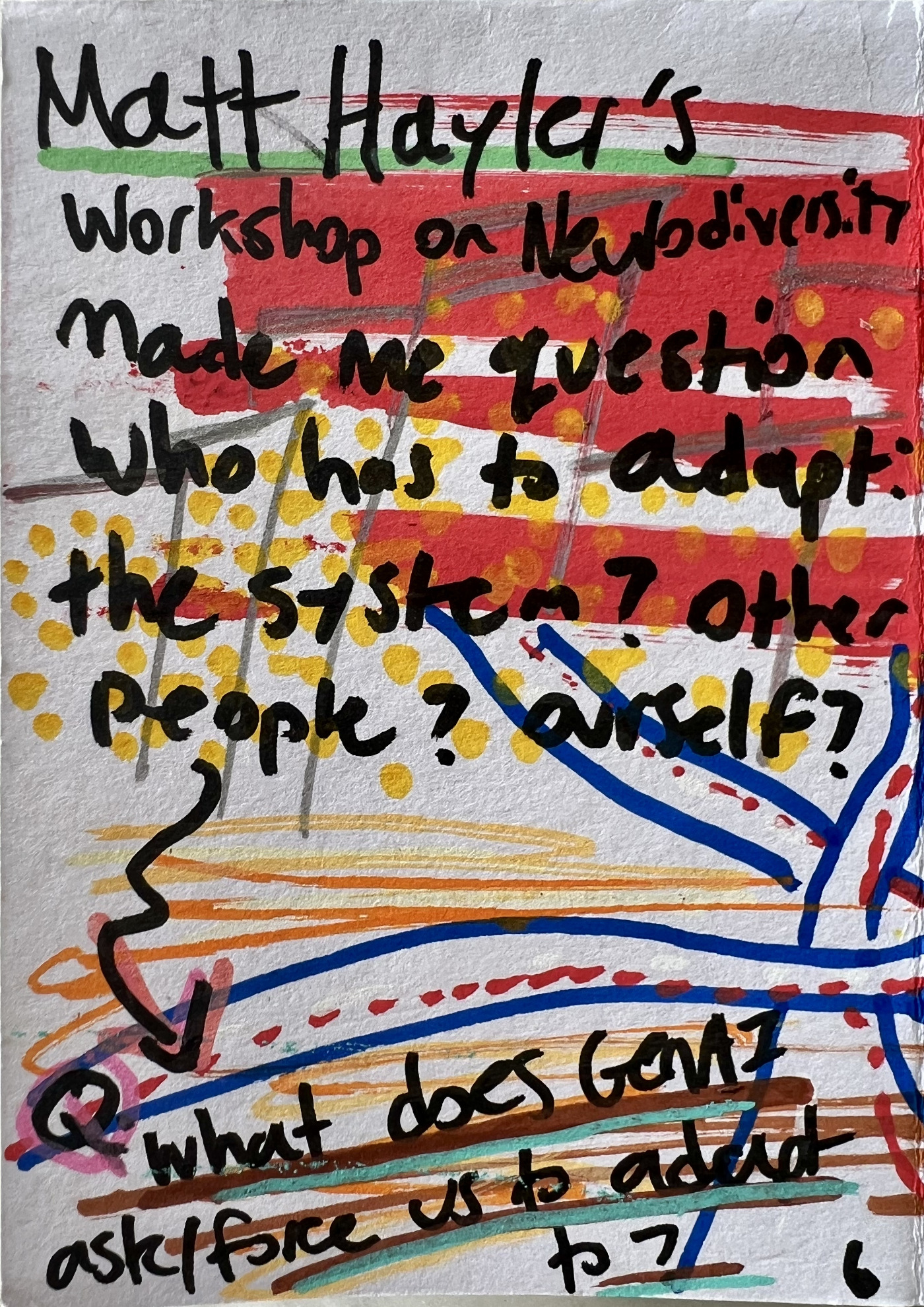
Matt Hayler’s workshop on neurodiversity brought this question into focus. I learned that inclusion is not just about making space.
In reflection, I found that players can enter experiences without having much control in how to participate. Think of a game that offers no ability to change its controls or settings. Technically, you can play, but practically, you can only play in the way the designer has already decided.
That complicated my enthusiasm for adaptive technology. I had often treated personalisation as an obvious benefit. If a system could recognise that someone was struggling, surely it could respond appropriately.
Perhaps.
But the system would first have to decide what ‘struggling’ looks like. It would also have to decide what ‘success’ looks like. Just like the word ‘help’, those terms carry many assumptions.
My notes from the workshop contain a quote that I have bolded, underlined and highlighted, “…only if you give up more of yourself to the machine.” I took this as a provocation about how current systems demand information before it can understand you as a person, and how that information changes the interpretation of the user.
In my own research, this problem becomes quite visible.
← Back to zine page 6
Movement data can show that someone has not entered a target area. It cannot, by itself, explain whether they are confused, considering an action, uncomfortable or content to watch. In one test, a participant stood still for around three minutes while deliberating and observing. The system began to interpret the lack of movement as an absence of participation and eventually attempted a restart, which contributed to a crash.
Yet, during the post-interview, the participant was revealed to be captivated. They were thinking about how to solve the puzzle, but they wanted to do so in their head before moving their body.
My designed system could not understand that.
From the data it could see, stillness looked like inactivity.
The community-based research discussions during the workshops took this further. Hesitation or refusal may reveal the limits of a design rather than a participant’s failure to engage. I need to distinguish someone being excluded from someone choosing a different way to take part.
Adaptation is only helpful when I am prepared to question what the system thinks it has understood.
And that leads into another question that kept returning throughout the programme.
Why should a person trust the system’s interpretation in the first place?
Would you trust a human more than a computer? What if there was a mix of both?
Why do we trust a computer system? What if that computer system was a hybrid of human-AI cognition?
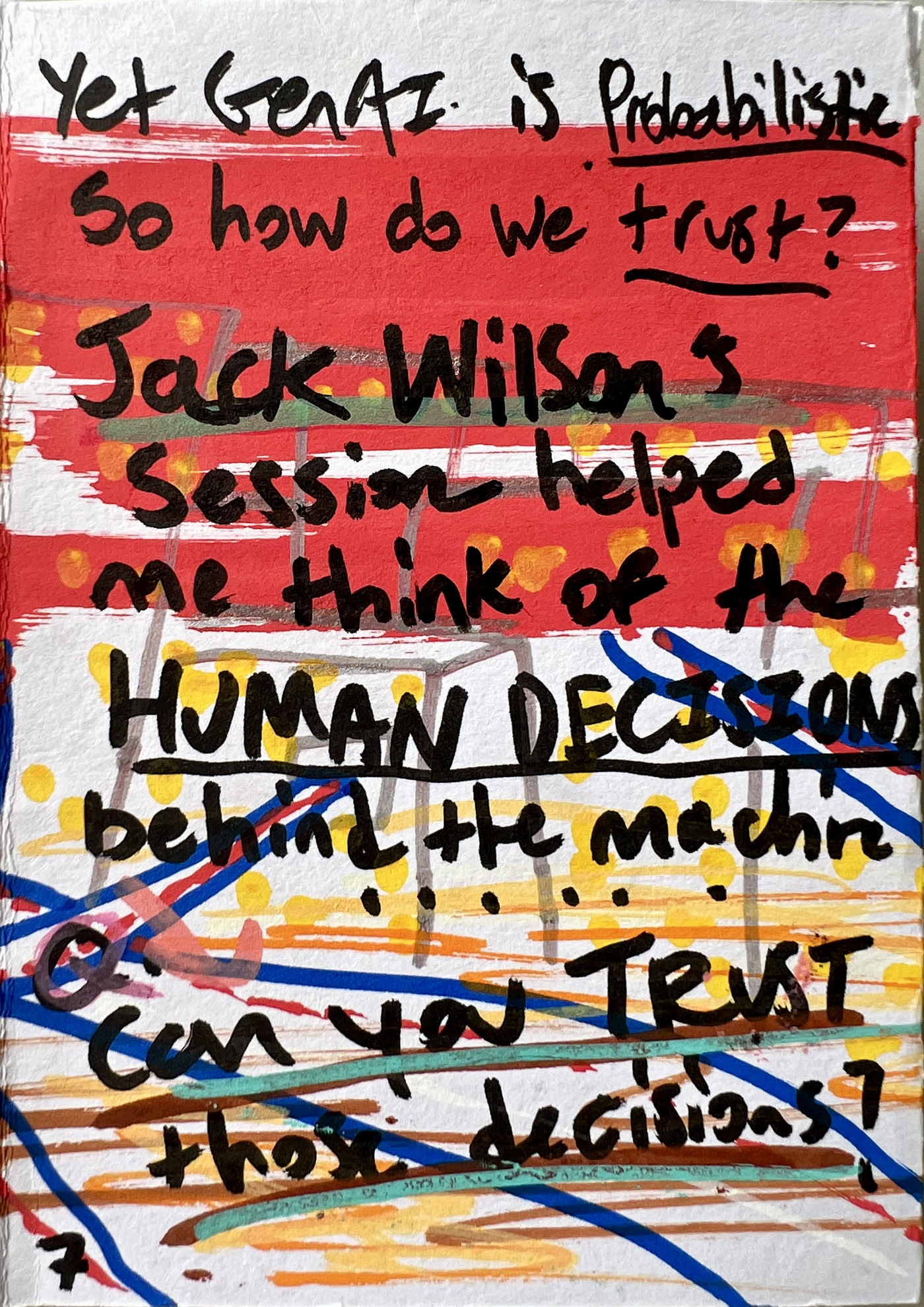
Trust kept returning in my notes even when it was not the stated topic of a session. Jack Wilson’s session on truthfulness helped illuminate the concept of trust further. In words, the phrase “an answer does not have to be accurate to sound correct” quite aptly sums up trust, at least for this moment in the context of Generative AI.
In an earlier workshop reflection, I wrote that trust cannot be automated into existence. That does not mean engineering, reliability or regulation do not matter. They do matter enormously. What it means for me is that when we say we trust the computer, we are often trusting a chain of human decisions that we cannot see.
For my own work, I want to develop an AI facilitator whose actions and ideas people can question, just as we do with friends (think of escape rooms or solving mysteries together). Piotr Mirowski’s session on creativity support offered a useful connection. His discussion of improvisation, including the principle of making one’s partner look good on stage, gave me another way to think about facilitation. The system could help people contribute without taking over the performance.
So then human-AI cooperation comes into the picture.
There are considerably more tools available now for making multiplayer games, and even GenAI can make parts of multiplayer coding and development more efficient. There is an adage in video game development that making a multiplayer game is almost like making two games at once.
Yet for all of that technical complexity, much of the fun still comes from something comparatively simple; other people.
Consider Among Us, Fall Guys, or the more recent wave of games loosely described as ‘friendslop’, such as PEAK or Meccha Chameleon. They are mechanically different, but much of their appeal comes from the social mess around the mechanics. Someone makes a wrong move, your perfect plan collapses, and chaos ensues. A friend then tries to help and somehow makes everything worse. People laugh, recover or restart, and keep on playing.
Even a failed attempt can become a part of the game that we remember.
My research is not fully confined to the digital world. The experiences I build are co-located. People physically stand together in a room, interacting through a mixture of hardware, software, audiovisual systems and sometimes human facilitation.
So consider a group that completes a puzzle quickly because one confident participant directs everybody else.
From the software’s perspective, that result might look excellent. The task was completed, and the completion time was short as well; all great metrics.
Yet, those measurements tell me very little about what happened socially between the participants.
Did the others enjoy following someone who understood the puzzle more quickly? Were they relieved that somebody took charge? Did someone else have an idea but never found the opportunity to contribute?
Leadership itself is not necessarily the problem. Sometimes being led is exactly what is needed or wanted.
The problem comes when I, as a designer or developer decide in advance what ‘successful’ cooperation looks like.
This becomes particularly important in themed entertainment. Guest satisfaction matters. Throughput matters too. At some level, designers are constantly negotiating a question that sounds almost absurd when written plainly; what is the least amount of time in which we can give somebody the most satisfying experience?
The risk comes from when the measurement becomes the meaning.
If faster completion repeatedly becomes evidence of a ‘better’ group, then the system, or the developers interpreting its data, may begin privileging behaviours associated with speed. Someone who takes longer to think, communicates differently or prefers to observe before participating may appear inefficient by comparison.
Over time, if those interpretations were repeatedly embedded into systems beyond one experience, I worry about the emergent categories we might create around people.
‘This participant did not respond in time to the cue’ can become ‘this participant is making the experience difficult.’
‘This participant required more time’ can become ‘this participant is inefficient or unproductive.’
I want to be careful here. My experiments have not demonstrated that this will happen. GenAI does not automatically produce these outcomes either. Much depends on what designers choose to measure, what the system is asked to optimise and how people interpret the resulting data.
But that is precisely why the question matters!
The participant who stood still for three minutes returns to me here. The system saw inactivity, but the participant was just thinking.
That changes the questions I bring to my own analysis. Who can propose an idea? Who gets the response? What happens when somebody interprets a cue differently?
None of these moments has a fixed meaning. I cannot decide that every hesitation to interact represents resistance any more than I can decide that every completed task represents cooperation.
I must ask, and I believe that the designed system should too.
This is why my research combines system logs with observation, interviews and my own developer reflections. Logs help establish what happened and when. Participants help me understand what they thought was happening. My own reflections force me to confront how badly I sometimes want the experience I built to work.
There is another uncomfortable parallel here to my own exploration and use of GenAI in my development workflows.
When a GenAI agent completes more tasks for me, I can look at the output and think I have become more productive.
But have I become a more satisfied creator, or have I simply become better at supervising production?
I grew up enjoying the word VICTORY flashing across a screen. I should probably be careful about replacing that with another completed task on a dashboard. What does victory actually mean for work; if not more and more work?
The AI-EDI programme has made me more accountable for how I reflect on the accountability and accessibility of my designed systems and resulting experiences. Most of all, the question of why has become the first question, and it is one that often is the last answered.
I still want to design experiences that enable people to cooperate. I am simply less willing now to define and dictate what cooperation should look like for the guests in the experience.
Toward the flourishing edge
What I valued most about the AI -EDI programme was having people with whom these questions could be openly discussed with.
Almost a year earlier, in April 2025, I attended the three-day Flourishing Edges Unconference supported by CoLab Dudley and Midlands4Cities.
Instead of another conventional academic event, I found myself soil snorkelling, imagining the world through a limpet, and weaving willow and birch with my hands. We spoke about systems of care, regenerative ways of being, commons, storytelling and multiple ways of knowing; all concepts that were intriguing, inspiring me to test them out on my own designed systems.
My professional and industry experience had long been filled with ‘sharp’ edges: the cutting edge, the bleeding edge, and emerging technology as disruption. I had spent much of my career chasing the latest technologies before they became ordinary, knowing that sometimes they would fail spectacularly, but always believing and striving for the moment when they would unlock something new and novel.
I took pride in being willing to walk that edge and sacrifice blood, sweat and tears to achieve my goals.
Yet during the unconference, while weaving willow and birch together, I became caught on the image of the edge itself.
Why did the edge have to cut and make wounds bleed?
The mythical blood thirsty blades of Muramasa or Tyrfing spring to the forefront. Why had I accepted an image of technological progress in which being hurt by the process or disrupting a process was evidence that I was doing something worthwhile?
Perhaps I could walk another edge.
I began calling it the flourishing edge after the name of the conference.
In my reflection after the unconference, I imagined replacing the trail of cuts left by the bleeding edge with seeds. Some would fail. Others might germinate. A few might become something another person could tend to long after I had moved on. This reminded me of the phrase ‘a society grows great when old men plant trees whose shade they know they shall never sit in’.
It was deliberately hopeful. Probably a little idealistic.
Yet I still like it better as a worldview than my previous more ‘dystopic’ mode of working.
But the AI EDI programme made it harder for me to leave flourishing as a metaphor, and that challenge is warranted, and much needed.
Hidden labour leaves me wondering who is left sustaining the systems I build or use. Neurodiversity asks who is expected to adapt, and most importantly why? Trust asks who is accountable when something goes wrong. Community-based research makes me questions if I am doing research with people or simply extracting information from them.
And my own experience with GenAI, has come to question what productivity is really, especially when every saved hour becomes another opportunity to produce more.
One of the journalling prompts that has stayed with me throughout my time in my PhD is “who do you lean on, and who leans on you?”
When I started, my answer was to say, “everyone and everything”.
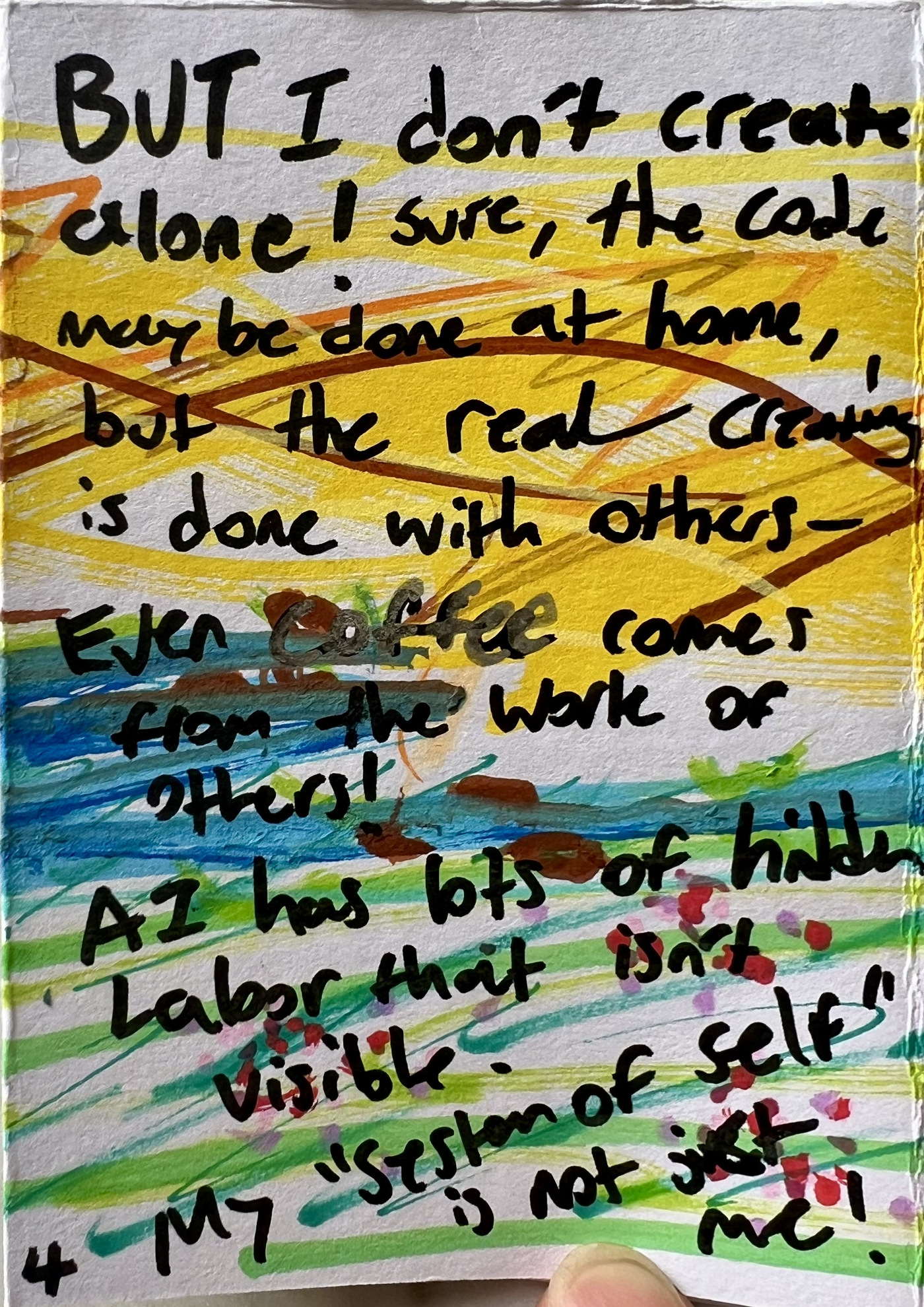
Looking at the cup of coffee beside my computer now, that answer feels less poetic and more practical. The coffee cup depends on a farmer I will probably never meet and on systems of water, soil, transport and energy that sit far beyond my view, all modulated by human design.
GenAI is perhaps not so different. Behind the apparently simple chat interface are massive data centres, armies of engineers, lakes of datasets, tired workers, electricity, water, chips, networks and institutions.
My own ‘system of self’ is therefore not particularly self-contained.
I lean on an extraordinary number of things to produce the work that carries my name.
The question that follows is uncomfortable but always necessary;
What do I give back?
For me, this is where the flourishing edge becomes useful.
It cannot simply mean making nicer technology. It cannot mean putting the words ‘human-centred’ onto a project while retaining the same assumptions about productivity, growth and optimisation. And it cannot mean that I declare something inclusive because I intended it to be.
Flourishing has to become something I can examine.
In my research, perhaps that means allowing somebody to pause without immediately treating the pause as failure. Allowing someone to question the AI. Allowing a group to discover cooperation rather than forcing them into my preferred version of it.
In my own working life, it means asking a similarly difficult question.
← Back to zine page 8
When GenAI saves me an hour, what happens to that hour?
Do I rest? Do I spend time with somebody? Do I go outside? Do I make something that would otherwise have remained an idea?
Or do I simply fill the newly available space with another task?
If every efficiency creates another expectation of productivity, I have not actually gained much freedom. I have simply accelerated the machine I am standing inside, like a treadmill that only gets faster.
I am still excited by technology. I still want to build things. But I no longer think technological capability for productivity, merit and capital is a sufficient reason for doing something.
Knowing more about coffee does not undo the environmental or human cost of producing my cup. Knowing that GenAI depends on hidden infrastructures and labour does not automatically make my use of it fair. Knowing and questioning, and most importantly, being aware, is the point. You do not need an immediate solution.
Some things I can change personally. Others require institutions, industries, governments and communities to change together, all of which take time.
And when I say that technology is helping, who exactly is flourishing?
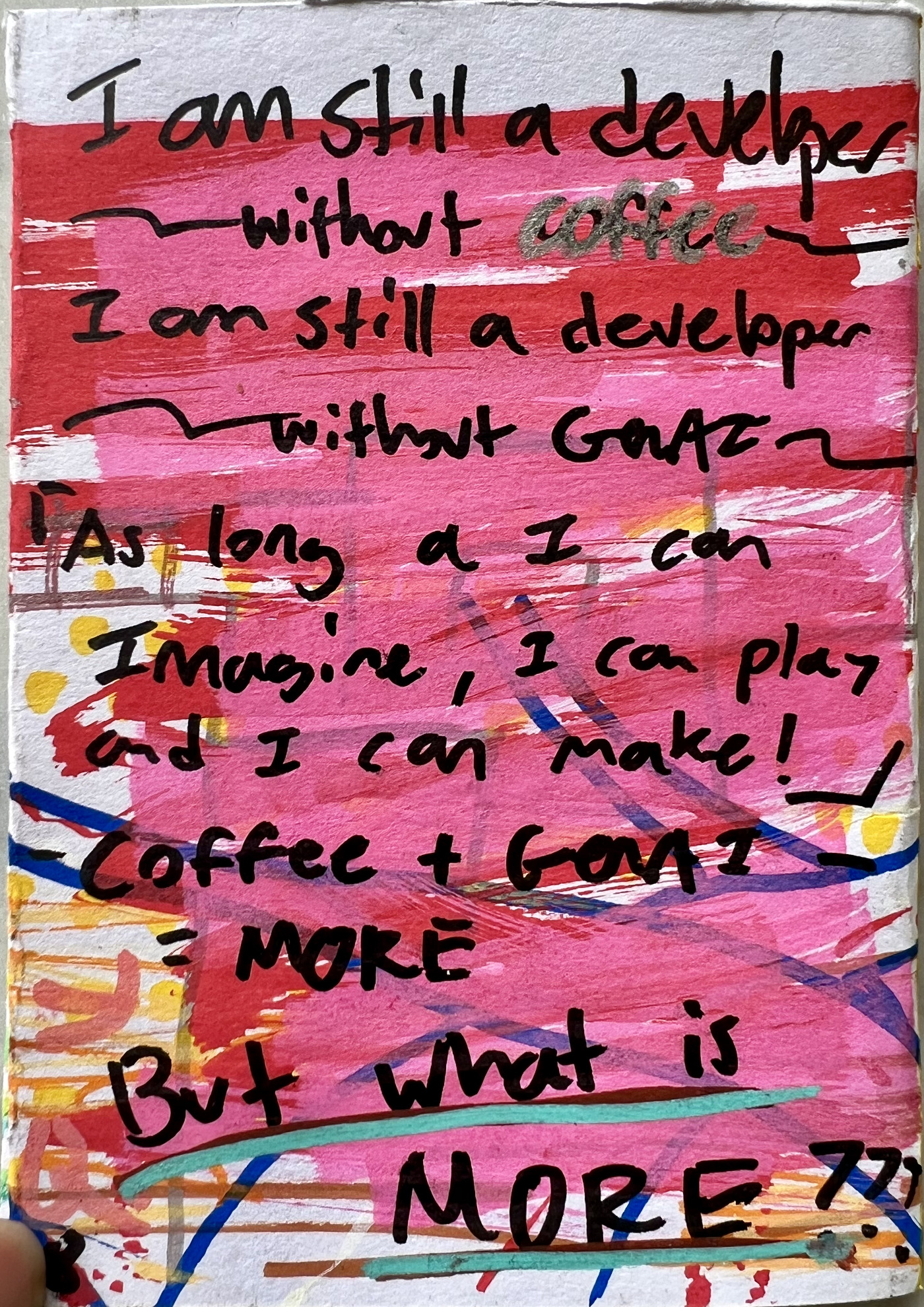
I am still a developer without coffee.
I am still a developer without GenAI.
As long as I can imagine, I can play and I can make.
Coffee and GenAI may allow me to do more.
But what I want to understand now is whether that more can give something back to the people and the world I lean upon, while leaving enough room for all of us to live.
That is the greatest takeaway I have from the AI-EDI Workshops and Conference.
Further reading
If you found my writing interesting, here’s a short selection of books and essays that I think you’ll enjoy as much as I did.
Madhumita Murgia (2024), Code Dependent: Living in the Shadow of AI. An accessible route into the human labour and social consequences that sit behind GenAI systems.
Miguel Sicart (2023), Playing Software: Homo Ludens in Computational Culture. Useful for thinking about play, agency and the ways software can organise us even while we are enjoying it as entertainment.
Bernard Williams (2002), Truth and Truthfulness. A philosophical foundation for my questions of responsibility and what makes something worthy of trust.
Donna Haraway (1988), “Situated Knowledges.” A key influence on how I think about partial perspectives.
James Bridle (2022), Ways of Being. A broader invitation to think about intelligence beyond the human and to place technological systems back within ecological relations.
David Bollier and Silke Helfrich (2019), Free, Fair, and Alive. A practical exploration of commoning and how shared systems might be organised around mutual responsibility.
↑ Back to the essay introduction